
Assessment vision examples
Practice: how programmes at VU have shaped their assessment, and which design principles show up in it.
About this collection
Use the selectors on this page to filter the examples that are described in the Vision for future-proof assessment. However, below they are ordered based on the VU Taxonomy for Programme Outcomes and Manageable group sizes for practical application.
Each example includes links to other resources to help you in designing your own assessments.
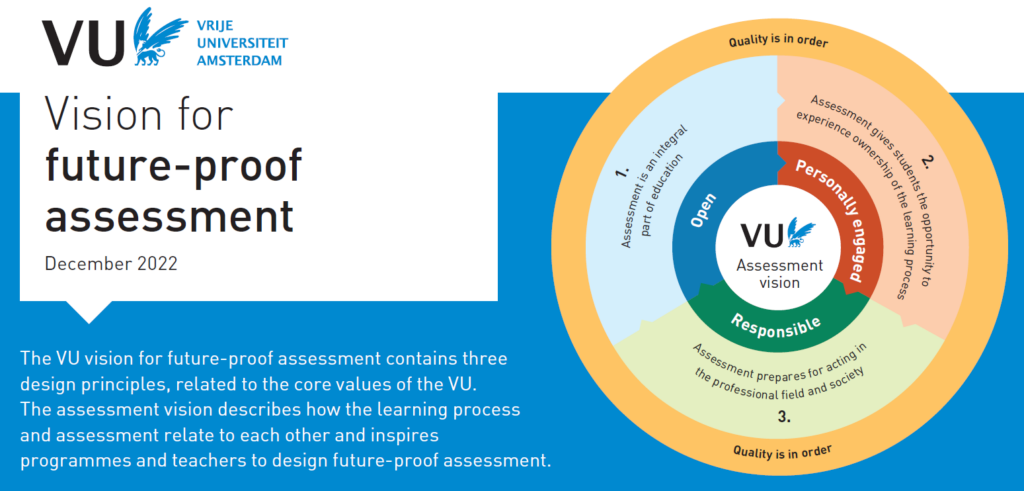
Have a look at the complete description of the Vision for future-proof assessment on vu.nl or download the PDF with the examples and descriptions.
- Design principle 1: Assessment is an integral part of the learning process
- Design principle 2: Assessment gives students the opportunity to experience ownership of the learning process
- Design principle 3: Assessment prepares for acting in the professional field and society
Academic and personal development
During the bachelor’s programme Criminology, students are guided in developing competences through the professional and personal identity (PPI) learning pathway.
Academic Labs
The VU participates in several Academic Labs . These are partnerships between academic institutions, (public) organisations and governments.
Community Service Learning in the Global Health minor
In the Global Health minor, students build a knowledge base and work on a Community Service Learning (CSL) project proposed by an external partner. In doing so, the challenge-based learning model is applied.
Contributing to health and well-being in the city through Community Service Learning
Students in the Health In The City course of the bachelor’s programmes Health and Life Sciences address a societal problem from the working field. Students use their academic knowledge to contribute to society.
Educational innovation and innovation policy in practice
In the master’s programme Pedagogical Sciences, students within the Policy and Practice of Educational Innovation course go on a working visit to organisations involved in education (and innovation), for which groups of…
Feedup, feedback en feedforward
In the Course Integration Lab (part of the BSc Interdisciplinary Social Studies) at the University of Amsterdam, students determine their personal learning goals in the areas of problem-solving and collaboration skills…
Formative dialogue in practice at Applied Physics
At Applied Physics within the Bachelor of Engineering at Harvard University (Eric Mazur), formative dialogue has been given a place.
Freedom and frameworks: Free assignments in teaching and asssessment
In the first-year course Ethnographic Monographs of the bachelor’s programme Social and Cultural Anthropology, students experiment with ways to convey a message.
How students develop into academically trained museum curators
Within the two-year master’s programme in Curating Art and Cultures, students are prepared to become academically trained museum curators.
Peer feedback with FeedbackFruits
In Pharmaceutical Sciences and Drug Discovery and Safety, the FeedbackFruits tool is being used for peer feedback.
Portfolio Accounting and Control
In the Accounting and Control Portfolio, students work within four modules on assignments that prepare them for the professional field after the master’s programme Accounting and Control.
Professional Tasks
Fontys University of Applied Sciences' ICT study programme wants students to experience ownership of their own studies from day one. And therefore also feel responsible for their own progress and performance.
Programmatic assessment in the master’s programme Dentistry
In some clinical pathways of the master’s programma Dentistry, Entrustable Professional Activities (EPAs) are applied: observable tasks entrusted to competent students.
Programmatic assessment in the master’s programme Medicine
In the master’s programme Medicine, assessment is programme-based, leaving room for student development. Students are not evaluated on one fail, but over a pattern of data points over a longer period of time.
Projects learning pathway
In the bachelor’s programme Science, Business and Innovation, four innovation projects combine theory with a practice-oriented assignment.
Screencapture someone’s imagination: Students show their command of statistics in a screen capture
At Amsterdam University College (AUC), courses cover a 16-week semester. AUC applies continuous assessment, where assessment is spread over the semester.
Self-assessment as a tool for increased learning efficiency
In the honours course Rebuilding Education, students are closely involved in their personal learning process through self-assessment.
Students determine their own form of assessment
In the honours course "Big Data Meets Small Data" at the Faculty of Social Sciences, students have the autonomy to select their own form of assessment to demonstrate their achievement of the learning objectives.
Students formulate their own formative multiple-choice questions
The bachelor’s programme Pedagogical Sciences uses Peerwise. Peerwise is a tool in which students can make multiple-choice questions for each other and then answer each other’s questions.
Team-Based Learning
In the Bachelor of Communication Science, the courses News and Journalism and Introduction to Communication Science incorporate team-based learning (TBL) as an educational model.
The connection between theory and practice in teacher training programmes
In the one-year master’s programmes to become a teacher in Dutch secondary education (Leraar Voorbereidend Hoger Onderwijs), theory and practice are offered in conjunction.
Toetsing in een andere dimensie
The skills pathway in the bachelor’s programme Law concludes with Moot Court, in which students experience a ‘toga profession’.