

Chapter 6
Critical thinking
20 min read
Critical thinking can be regarded as the disciplined practice of evaluating information, arguments, and beliefs using logic, evidence, and intellectual humility. Though the term is widely used by educators, professionals, and policymakers, it is frequently misunderstood. It is often used without giving it sufficient thought and acknowledging, for example, disciplinary differences and difference between day-to-day critical thinking and professional or research induced thinking. In view of the paragraphs about the risks of generative AI, the general feeling is that generative AI will come at the cost of critical thinking abilities. Some researchers however see opportunities to involve generative AI to improve critical thinking. We will dive into this in the following paragraphs.
#6.1Knowledge is conditional for critical thinking
Before discussing the role of knowledge in critical thinking, it helps to name a debate that often remains implicit. Is critical thinking a general, transferable skill that students can apply across domains once they have learned it? Or is it tied to expertise within a specific domain? Much of the public and educational debate assumes the former, but research in cognitive science points in the opposite direction: the ability to reason well, solve problems, and make sound judgments depends heavily on prior knowledge within the relevant field (Van Gelder, 2005; Willingham, 2020). Someone who reasons sharply about economics does not automatically reason sharply about literary criticism or molecular biology. This is why a foundation of domain knowledge is not optional but conditional for critical thinking.
The main critique on generative AI is that it is a statistical machine and that it consequentially can make outright mistakes. It can provide incorrect facts and present them as correct. Many teachers focus on this characteristic of language models and, rightly so, fear that students will not be aware of these errors or be able to detect them. Teachers focusing on correctness of information (or concepts, procedures, numbers, proofs etc.) sometimes label the inability to detect errors as a ‘lack of critical thinking’ by the students. However, this ignores what education is for. Students enter higher education with only a limited ability to think critically. Teaching them that ability is the task, and educators are responsible for having increased it by the time students leave. A great and worthwhile task.
It is true that to analyze a problem effectively, students must first possess sufficient prior understanding of the relevant domain. But knowledge by itself is not enough for students to get to critical thinking or questions. At the same time students are still learners, it's important to acknowledge that they still lack certain knowledge. As a teacher, you are there to guide them in this process and not judge their lack upfront.
For example, a student cannot critically evaluate a historical argument without knowing the relevant facts, nor assess a scientific claim without grasping the underlying principles. Without this foundation, learners risk engaging with questions they are not yet equipped to address meaningfully (disruptive friction, see paragraph 4.4.4). So it's important to acknowledge and communicate to students the importance of this knowledge as a stepping stone for learning and reaching a level of critical thinking. And not just point out the questions that you may perceive as uninformed.
Oakley et al. (2025) describes this in detail in the article ‘The Memory Paradox: Why Our Brains Need Knowledge in an Age of AI’. For humans to effectively work with AI, they need to maintain strong internal cognitive models (or "schemata" and neural manifolds), that allow them to critically evaluate, refine, and guide AI-generated output.
Research into inquiry-based learning consistently shows that it is less suitable for efficient knowledge building. This is because unguided discovery learning is problematic for most learners due to the too high cognitive demands of the inquiry process itself (Van Joolingen et al., 2007). Therefore, direct instruction and deliberate practice remain essential (Kirschner et al., 2006). These practices are the most suited to effectively acquire foundational knowledge that is functionally sufficiently automated (second nature, or working knowledge), so that cognitive resources are freed to process and acquire new information and insights. Only then can learners productively explore the boundaries of what they know and do not know.

Generative AI adds a further layer of potential misinformation: by their nature, generative AI systems produce artifacts that carry some degree of incorrectness while seeming correct at first glance. For any curriculum that pays attention to critical thinking, a focus on logical flaws alone is therefore not enough. It has to go together with sufficient knowledge of the domain, or with the inclination to acquire the facts, principles, methods and theories quickly.
However, this brings us also back to the paragraph 3.1 about the inverted Bloom’s taxonomy. That paragraph makes two arguments. The first is that learning is a messy process, in which learners move back and forth in cycles of understanding and schemata building. The second is that generative AI may let students approach more complex problems than before, because the technology generates and analyzes explanations, arguments and lines of thinking so much faster.
The line between premature questioning and productive inquiry is getting thinner given the presence of generative AI, but one cannot always know in advance on which side a particular question falls. This uncertainty is not a flaw, but exactly touches the reason of education: educators are there to guide students along this path.
#6.2Logic
Besides knowledge, critical thinking requires a good understanding of logic. For example, deduction draws specific conclusions from general principles: if the premises are true, the conclusion must follow (e.g., "All humans are mortal; Socrates is human; therefore, Socrates is mortal"). Induction moves in the opposite direction, from observations to broader generalizations (e.g., observing repeated sunrises and inferring the sun will rise tomorrow). Understanding these and other forms of reasoning and their limitations helps learners to construct sound arguments and identify flawed ones.
A critical thinker identifies claims and the evidence that support the claims, recognizes common fallacies, detects hidden assumptions, and seriously considers alternative explanations. The guiding questions are: What exactly is being claimed? What evidence supports it? What would change my mind?
Generative AI likely calls for a stronger emphasis in education on training students in logic. And logic is not easily learned. Specialized courses, and ongoing attention during all courses and (research) projects are needed.
#6.3Logical fallacies
Critical thinking therefore requires deliberate training, even more so when using generative AI undermines or challenges it. This training can be incorporated into formal education (such as university educational programs and courses) and students can be given sufficient time for training and application in projects.
This is different when looking at daily or even professional life. And we think it is necessary here to emphasize that the political and societal attention for AI Literacy stems most from that background. Citizens, also well educated individuals, seem more and more to be unaware (and sometimes even unwilling) of their lack of knowledge and lack of effort to put in reasoning and are victim of logical fallacies.
In daily or professional lives, there are no program and course guard rails, and individuals must apply critical thinking independently themselves. That is not easy. It demands a conscious effort to pause before drawing immediate conclusions when confronted with a claim or event, whether from an advertisement, a politician, stakeholders with different interests, a company, or, indeed, an artifact produced by generative AI. Without that pause, reasoning quickly becomes unsound and prone to logical flaws. Or even worse people will react based only on their gut feeling. In the age of algorithmic social media bubbles, gut feelings are very easily confirmed and further inflated.
According to the A Broader Mind concept of VU Amsterdam, it is important that we pay attention to this form of critical thinking capacity and attitude in day-to-day normal life and profession. Being mindful of the following examples is important, but even more so in guiding students when using generative AI – which sometimes reinforces these biases.
- Confirmation bias is a flaw where one selectively attends to evidence that supports pre-existing beliefs while discounting contradictory information.
- Its close relative is Cherry picking, which involves deliberately selecting only those data points or examples that support one's argument while ignoring the broader body of evidence that might complicate or contradict it.
- And it is close to Causal oversimplification or Single cause fallacy, which occurs when a multi-causal problem is attributed to one visible factor while larger but less visible contributors are left out.
- Other frequent biases include:
- ad hominem reasoning, which dismisses arguments based on the character of the person making them object of the argumentation rather than their content;
- false dichotomies or black and white-thinking, which reduces complex issues to two opposing options when more nuanced positions exist;
- hasty generalization, drawing broad conclusions from limited examples;
- falsely appealing to authority: learners also commonly accept claims simply because an authoritative figure endorses them without examining the underlying evidence;
- post hoc reasoning: if because one event followed another, the first must have caused the second. Or assuming causation when there is only correlation. These flaws are pervasive precisely because they often feel intuitively correct and can be socially reinforced within groups that share similar assumptions.
Again, training learners to identify and avoid logical fallacies and become critical thinkers requires deliberate and structured interventions. It can be specific courses in logic, critical thinking or debating. Many institutions use the Critical Thinking Mini Guide from Paul & Elder (2019) for that purpose.
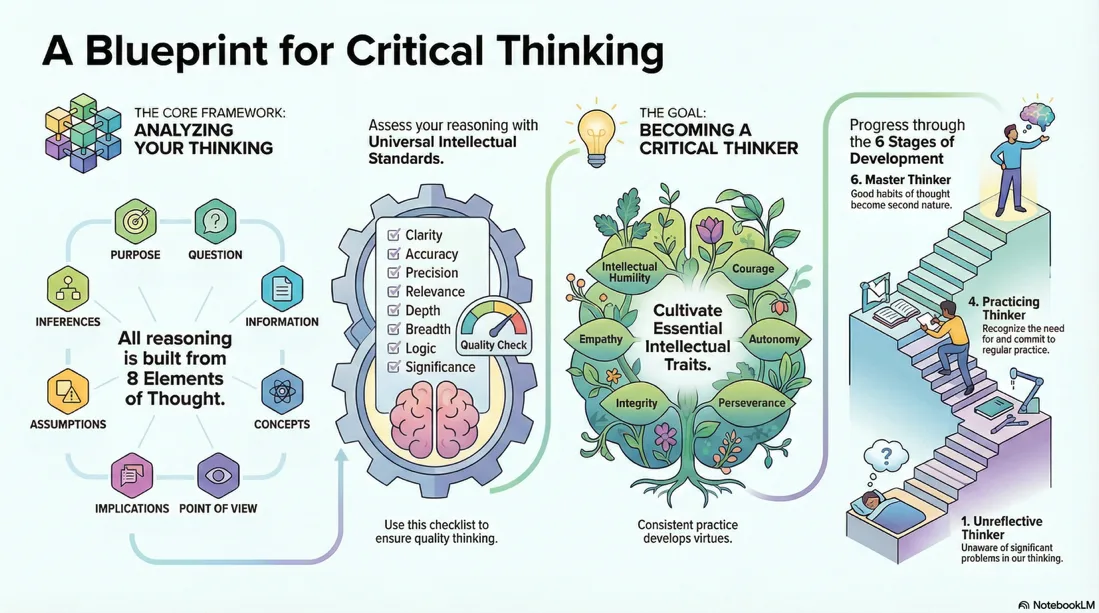
One effective approach is to have students analyze real-world arguments: political speeches, societal dilemmas, opinion pieces, social media debates, and business, marketing or research plans. They label the reasoning errors they encounter explicitly, including the cases where authors have cherry-picked evidence to build a misleadingly one-sided case.
You can supplement this with exercises where students construct the strongest possible version of an argument they disagree with, thereby forcing them to separate logical validity from personal conviction and to actively seek evidence they might otherwise ignore. Peer review exercises, where students critique each other's reasoning in a structured format, help develop the habit of scrutinizing arguments regardless of their source. An additional system VU Amsterdam has licensed is the system Civinc and (in the process of licensing) the critical thinking and argument mapping systems Kialo-edu. Additionally, teaching learners to slow down and articulate their reasoning steps in writing can expose hidden assumptions, inferential leaps, and selective use of evidence that would otherwise go unnoticed. Over time, these practices can shift flawed reasoning from an invisible default to a recognizable pattern that learners actively resist.
#6.4Moral convictions in relation to generative AI
Even as we encourage students to question assumptions and examine evidence, an unspoken boundary remains: certain positions function as moral convictions. These are the foundational assumptions that underlie ethical reasoning. Just as mathematics starts from basic assumptions that are accepted without proof, moral philosophy starts from claims taken as self-evident, such as 'causing unnecessary suffering is wrong' or 'people deserve equal respect'. They are not derived from other arguments; they are the premises from which moral arguments are built.
Moral convictions matter because they shape which conclusions a line of reasoning can reach. Two people who share the same logic, but start from different convictions will arrive at different conclusions, which helps explain why many ethical disagreements are so persistent: the debate is often not about logic, but about which foundational commitment underlies it. Such convictions can also carry internal inconsistencies, including ones widely held in academia, and recognizing these in our own thinking is part of teaching critical thinking by example.
How do moral convictions play a role in discussing the qualities and impact of generative AI? Mostly it comes down to discussions about bias in language models or the (lack of) applied technical guard rails.
#6.4.1Bias
First, the makers of the LLMs unconsciously or intentionally could reinforce several biases that could be considered a case of moral suspiciousness. This is the position presented by Bender et al. (2021). They reason that generative AI models are trained on large datasets of internet information and images, which likely over-represent stereotypical or the culturally most abundant, but not necessarily correct, information on the internet. And this is indeed the case, and hence Bender et al. (2021) talk about LLMs as stochastic parrots that amplify societal biases present in training data.
But it is not always so clear-cut what these kinds of cultural biases are. Think for example about questions related to cultural habits of individuals or groups. It makes a big difference if one were to ask a generative AI system to explain which hand gesture would mean ‘to calm down’ if you did not specify for which culture you are asking this. The same might be true, for example, about how to raise children or how to teach pupils. But also, simply when asked to generate a picture of a person. This person will likely be relatively young as compared to the average age in a society because the internet holds many more pictures of young people than old people.
A somewhat more covert bias will be for a multimodal model to generate a picture that shows ‘Humanitarian aid in Africa’. This particular example below sparked debate whether generative AI functions as a reinforcer of ‘poverty pornography’ (Fuchs, 2026). How does this relate to moral convictions?

#6.4.2Guardrails
With generative AI, much is said about the so-called guardrails. Though not often discussed, it is in the hands of the developers of generative AI models how they methodologically and technically ensure that a user will not get responses for requests that might generate taboo output. Think of outputs on how to build bombs, biological warfare arms, or how to commit suicide. Or in China: what happened during the Tiananmen revolution. The underlying moral axiom is that it is wrong – and even legally prohibited – to provide individuals with such information, as it could harm individuals or societies.
Things do change over time. Technical and ethical hackers have repeatedly demonstrated that guardrails can be circumvented. Or worse: the operators of some commercial models have loosened or removed guardrails themselves. Elon Musk, for example, did this for his Grok models in 2025, allowing the models to produce content that earlier generations of similar models declined to generate. Think of profanity, jokes about taboo subjects, and various image-alteration requests. Decisions like this reflect the moral axioms held by the people who build and steward AI systems, not only the technical capabilities of the models themselves. For students and educators, this raises a broader concern. The answers that a generative AI system provides are partly an artifact of choices made by its developers. Choices that can shift over time and that may differ between platforms.

#6.5What this could look like in your course
Translating the framework of this chapter into a specific course requires you to make a few design choices, and then pick concrete activities that fit your discipline and the placement of your course in the curriculum. On the new VU EduBase website we assembled a collection of exercises you could use for this purpose. For most teachers, the practical entry point is to combine a few choices about how the course frames critical thinking, with a selection of two or three activities from the companion that students can repeat across the semester.
A first design choice is whether your course will treat critical thinking as a separate subject, with one or two dedicated sessions early in the semester on logic, fallacies, and the role of moral axioms. Or will critical thinking be an integrated running thread with short critical-thinking moments embedded in every session and applied to the content on the agenda. Neither is universally better. Disciplines where reasoning patterns are central to the subject, such as philosophy, law, or economics, could benefit from the integrated version. Disciplines where critical thinking is more related to knowledge and precise procedural methods, such as the natural sciences, could benefit from a dedicated unit followed by targeted reminders. The choice should match the cognitive demands students already face in your content.
A second choice concerns the role of generative AI in the activities themselves. In some activities, students use AI as the object of critique, evaluating AI-generated arguments, summaries, or images for reasoning errors and biases. In other activities, students use AI as a partner to support their reasoning, prompting it to challenge their assumptions, generate counter-arguments, or surface alternative positions, and then critically evaluating what it produces. Both approaches develop different aspects of critical thinking. We assembled a collection of exercises that includes exercises of both kinds, including bias-recognition exercises, AI source-attribution debates, AI-generated argument analyses, and discipline-specific critical evaluation tasks for fields such as biology, engineering, and the social sciences.
A third choice is how critical thinking will be assessed. If you only assess the final product of student reasoning, you measure the outcome but not the process by which the student got there. For a process-aware assessment, we assembled a collection of exercises covering options that include critical reflection logs, annotated AI-output critiques, methodological reviews of AI-generated research designs, and personal AI use policies that students draft and defend. These options allow you to assess the reasoning quality directly, rather than infer it from the final text.