

Chapter 7
How does your AI use impact the environment?
25 min read
Generative AI uses a great deal of energy and water. And demand for the use of generative AI is increasing very rapidly, and so is demand for energy. Why is so much energy and cooling needed, and how does the climate impact of generative AI compare with the impact of, for example, industry, transportation, or agriculture?

#7.1What does your AI use really mean in terms of energy, CO₂ and water?
If you ask a generative AI a question through your laptop or phone, you do not see everything that is happening behind the scenes. Without realizing it, you are then using a large network of data centers, powerful graphics processors, and cooling systems that use a great deal of energy and water. In this chapter, we explore how this relates to environmental impact.
We look at three things: how much energy it takes to train models, how much energy and water are needed to generate answers, and how much CO2 is emitted. We take a global perspective in doing so. Then we zoom in on your own use and compare it with the environmental impact of other everyday activities. Think of watching YouTube videos, flying to your vacation destination, eating a hamburger, or taking a shower.
#7.2Why does training AI models require so much energy, water, and CO2?
Training models requires a great deal of energy because the values of the billions of parameters in the neural network of the LLM have to be calculated. To do this, tens of thousands of processors (GPUs) from the company Nvidia are generally used. Each processor requires about 700 watts of power. You can compare this to a consumer microwave running at nearly full power. A great deal of water is needed for cooling, and energy generated from fossil fuels causes CO2 emissions.
At the same time, it is difficult to determine how much energy is needed to train language models and what the CO₂ emissions are. First, because many factors play a role, such as the complexity of the model itself, but also the hardware it runs on, the questions you ask, and the energy source you use (for example, if you were to use renewable energy). Second, because the AI companies do not report their energy use (Vries-Gao, 2025b). In addition, the figures change quickly because of rapid technological developments. Much of the research on the environmental burden of generative AI is therefore based on estimates.
But how much energy are we talking about? Training runs for the current generation of LLMs, comparable to training sessions for GPT-4o, last about three months and consume about 45-56 gigawatt-hours of energy (You, 2025). So the training sessions require both high power and a long duration. The total amount of energy for training is therefore equal to the amount of energy needed to supply electricity to about 60,000-74,000 Dutch households for a year. That is quite a lot. It is sometimes claimed that you would even need a nuclear power plant for the energy consumption of a single data center. With the output of an average nuclear power plant (3000 MW), you could, for example, train 120 LLMs at the same time. If you use offshore wind turbines (10-15 MW each), you would need two or three of them. So comparisons should be made with caution.
So model training requires a great deal of energy, but how does that actually translate to a prompt? ChatGPT processes about 1 billion prompts per day (Ahmed, 2025). Suppose an LLM is used for about a year and we spread the energy for model training across that number of prompts, then we arrive at about 0.151 Wh (watt-hours) per prompt. You can read more about that below.
#7.3How much energy does it take when you ask an AI a question?
Every time you generate text, an image, or a video with a generative AI system, servers are running in a data center. That uses energy - but exactly how much?
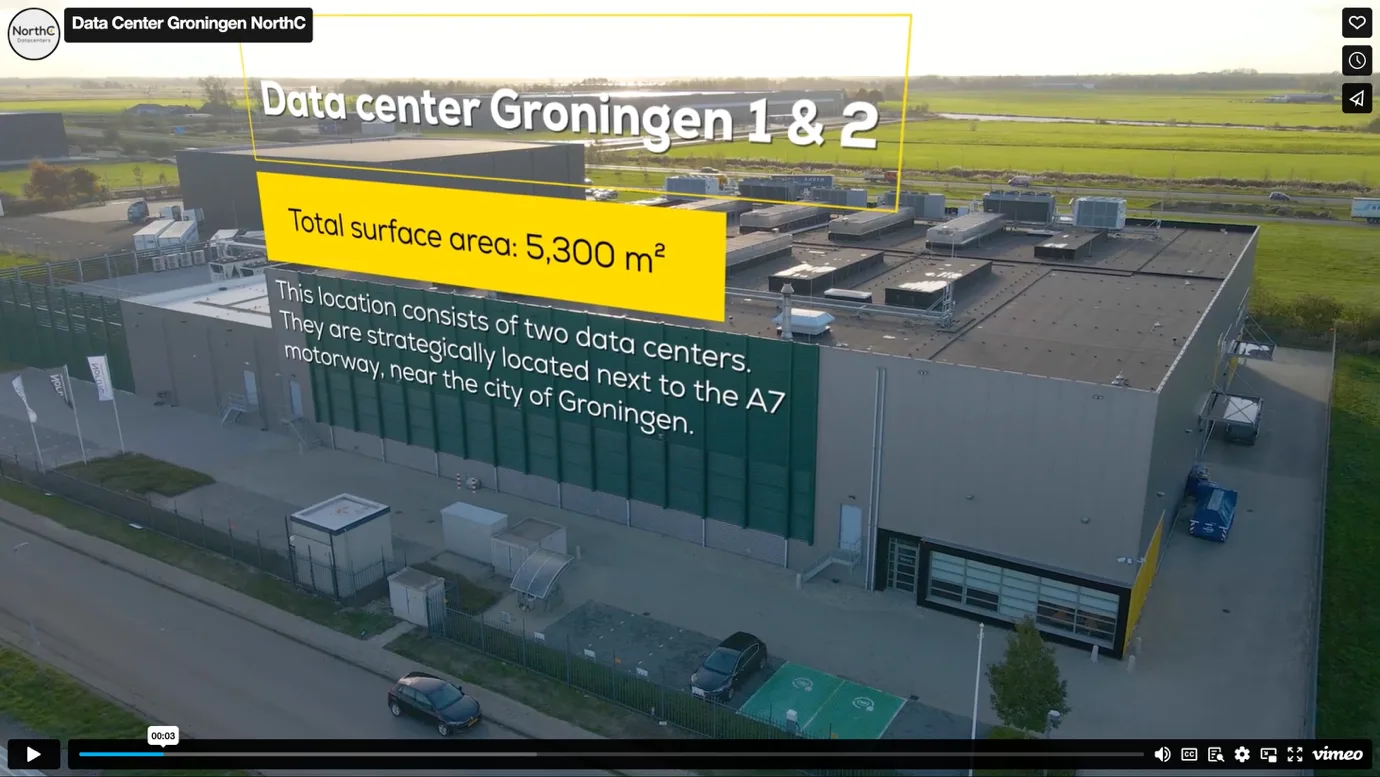
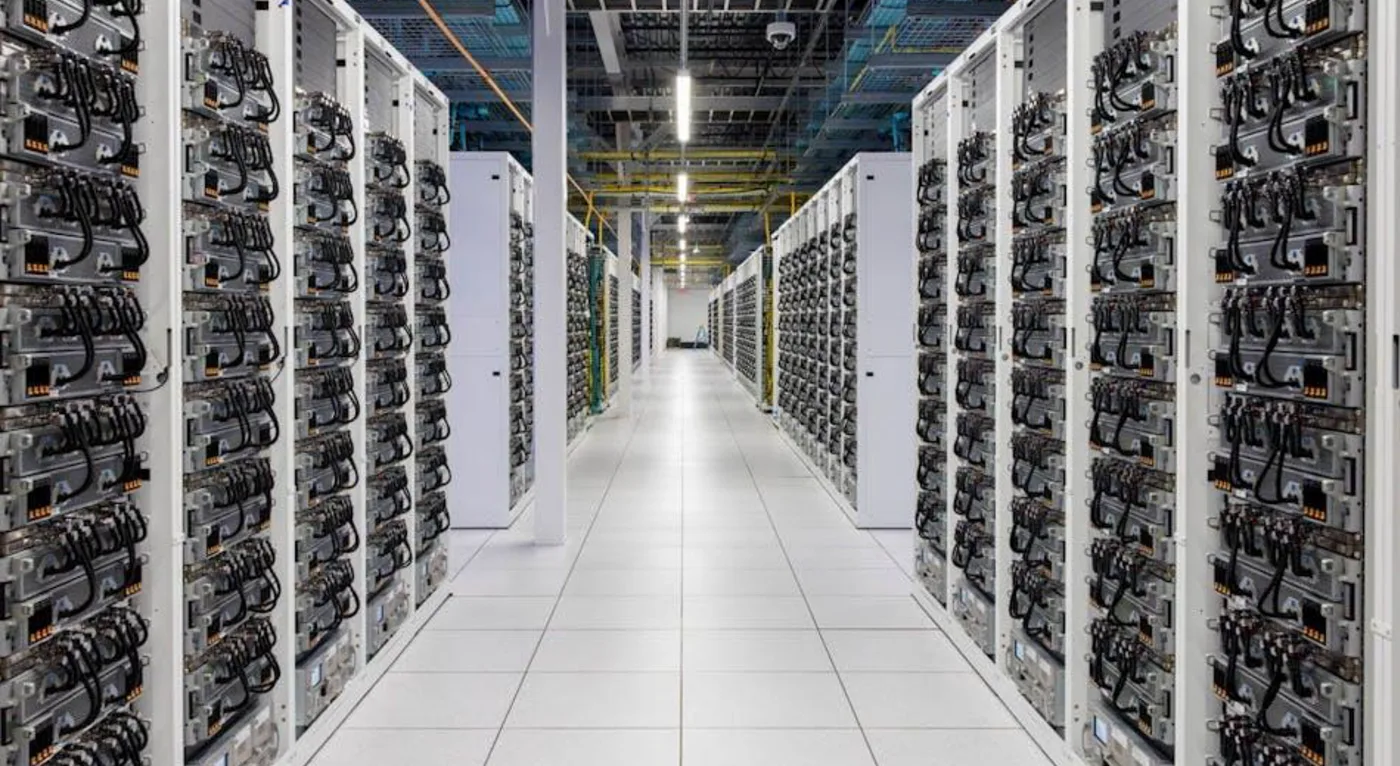
Little is known about the precise energy consumption. Comparative research is done using open-source models (see section 9.7 for more explanation of this). But the most widely used models are closed and therefore cannot be tested. In addition, they change continuously: new, larger models and so-called ‘reasoning models’ (models that converse with themselves) often require more computing power and therefore probably use more energy.
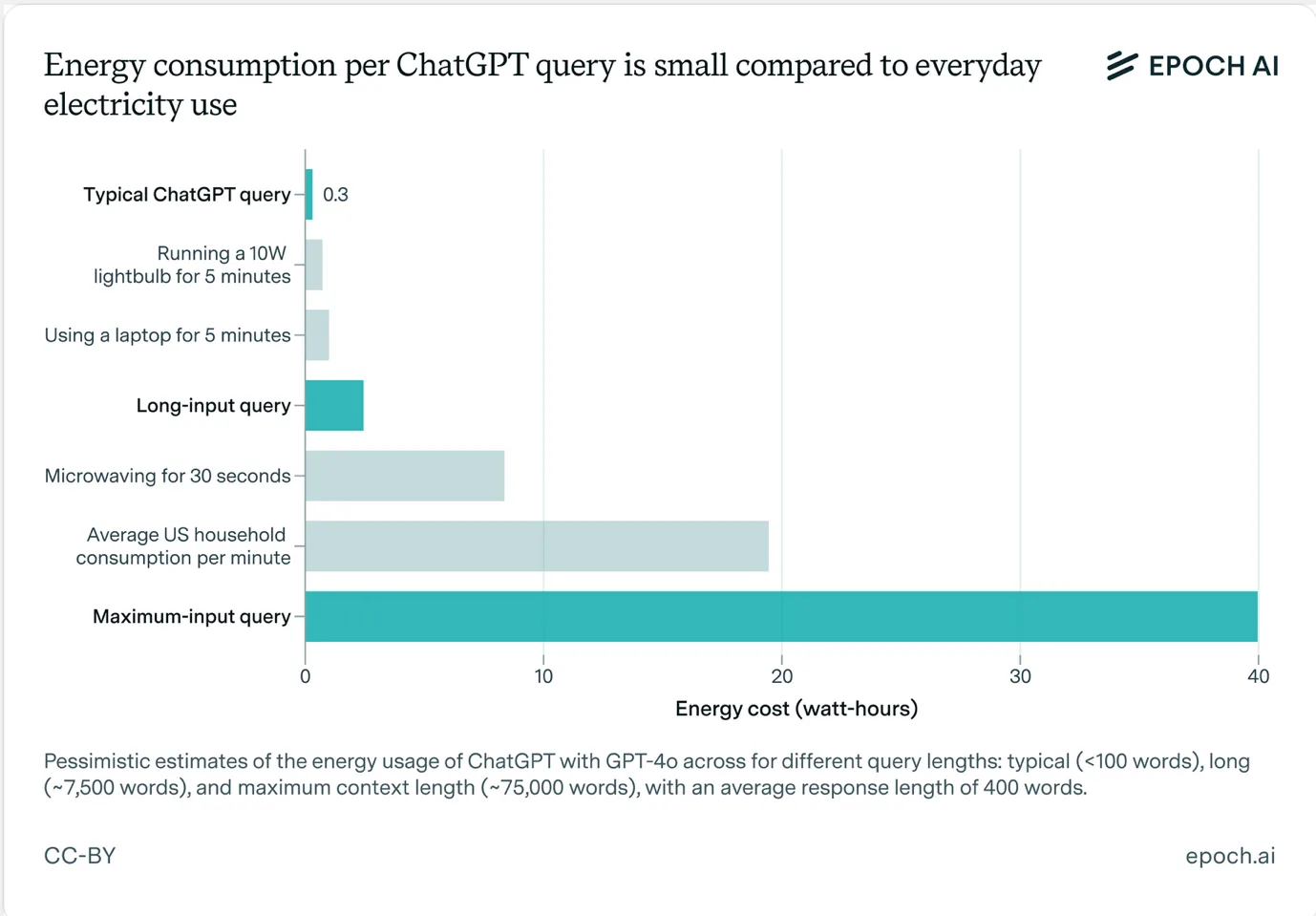
To still get an impression, a comparison is often made between asking Google a question and giving an AI a prompt. This is a complicated comparison because little is known about Google's energy use as well. But for the sake of the discussion, we will look at it briefly. The energy use for a Google search is estimated to be around 0.3 watt-hours (Wh), for example. An estimate for an average ChatGPT request was around 2.9 Wh for earlier models - almost ten times as much (You, 2025). But thanks to technological advances and more efficient models, such as GPT-4o, the energy use per prompt has now fallen to about 0.3 Wh. That would therefore be comparable to a Google search (You, 2025). For a long input, however, the energy cost is higher: it can rise to about 2.5 Wh for an input the length of a magazine article, up to 40 Wh for an input of about 200 pages of text. Generating images and videos requires considerably more energy.
#7.4How does prompting compare with other everyday energy use?
Whether the amount of energy needed to process a prompt is a lot or a little therefore depends on how you compare it with the use of other devices or services over a certain period of time. For example, 0.3 Wh is less than the amount of electricity an LED lamp or a laptop uses in a few minutes. Or equal to 0.9 seconds of use of a 1200-watt hair dryer or 7.2 seconds of operation of your 150-watt refrigerator compressor. So even for an intensive user, ChatGPT's energy costs will be only a small fraction of their total electricity use, and therefore also of the total amount of energy used worldwide. In the table below, we compare the amount of energy for 100 prompts (if you make intensive use of a generative AI system for a day) with the energy use of other everyday energy needs. Let the numbers sink in.
| Device/Category | Power | Energy use | Wh per day | Time for 0.3 Wh | Time for 30 Wh |
|---|---|---|---|---|---|
| Hair dryer | 1200 W | - | - | 0.9 seconds | 1.5 minutes |
| Refrigerator compressor | 150 W | - | - | 7.2 seconds | 12 minutes |
| Laptop | 50 W | - | - | 21.6 seconds | 36 minutes |
| LED lamp | 10 W | - | - | 1.8 minutes | 3 hours |
| 100 ChatGPT prompts | - | 30 Wh total* | 30 Wh* | - | Reference point |
| 100 ChatGPT prompts per day | - | 10.95 kWh/year | 30 Wh | 1 day** | 1 day |
| 2 hours of watching YouTube per day (tablet) | 22 W | 16.06 kWh/year | 44 Wh | 49.1 seconds | 1.36 hours |
| 2 hours of watching Netflix per day (TV) | 115 W | 83.95 kWh/year | 230 Wh | 9.4 seconds | 15.7 minutes |
| Average Dutch household | 331 W | 2900 kWh/year (CBS, 2018) | 7945 Wh | 3.3 seconds | 5.4 minutes |
| Standby consumption of a Dutch household | 51 W | 450 kWh/year (United Consumers, 2025) | 1224 Wh | 21.2 seconds | 35.3 minutes |
#7.5What does your AI use mean in the broader energy picture?
Although the energy use per prompt is small, the impact on a global scale becomes clear when you multiply it by the millions of daily prompts. In 2023 alone, ChatGPT’s annual energy use was estimated at 226.8 GWh - enough to fully charge more than 3 million electric cars once (You, 2025).
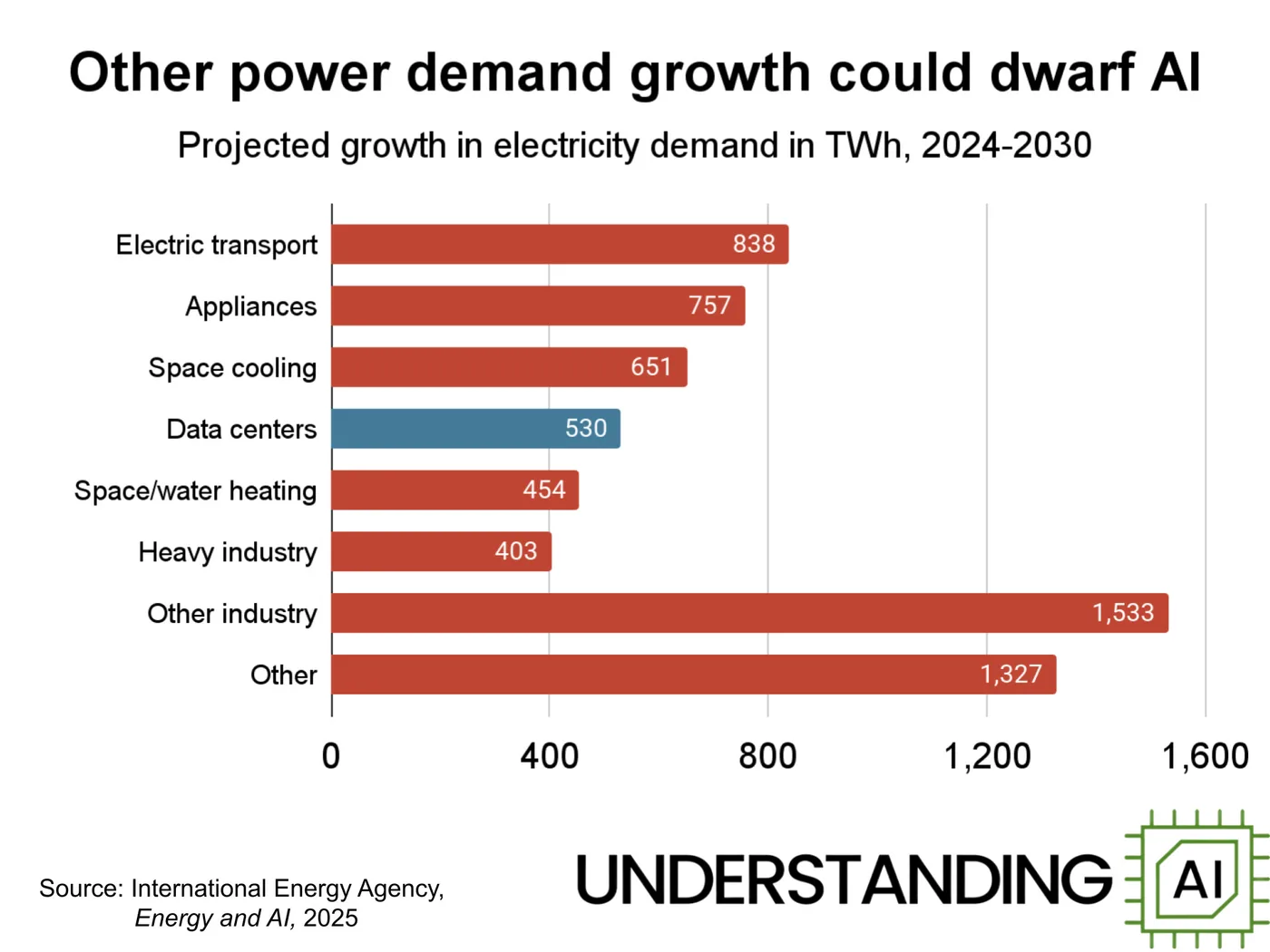
According to a report by the International Energy Agency (Cozzi & Gould, 2024) the processing of all digital data, mainly for AI, will consume more electricity in the US alone by 2030 than the production of steel, cement, chemicals, and all other energy-intensive goods combined. According to the report, global electricity demand from data centers will therefore more than double by 2030. It could possibly rise to an energy use amounting to 10 percent of total energy consumption in the United States. AI will be the main driver behind that increase, with demand from dedicated AI data centers alone expected to more than quadruple. One data center currently uses as much electricity as 100,000 households, but some data centers currently under construction will need twenty times as much electricity.
Newspaper headlines recently suggested that AI will cause a 165 percent increase in data center electricity use by 2030 (Verhagen, 2025). Of the increase to 650 TWh, general internet growth and general AI applications will contribute about 200 TWh. However, that increase had probably already been reached by the end of 2025 (Vries-Gao, 2025b).
It is important to keep in mind here that general AI use is much broader than generative AI applications alone, according to Masley (2025a), an essayist who takes a critical look at AI doom scenarios (see the note later in this chapter). Examples of general internet and AI use include:
- powering recommendation systems for the personalization of, for example, streaming platforms, e-commerce sites, social media feeds, and online ads.
- business operations such as data analysis, predictive and decision-making processes, search, and ad personalization.
- computer vision such as object detection, facial recognition, video and medical image analysis, and content moderation for automatically flagging inappropriate images.
- sound and audio (think of voice assistants and speech recognition systems, such as Amazon’s Alexa, Google Assistant, and Apple’s Siri).
Chatbots such as ChatGPT account for only 3 percent of total AI use (or 0.6 percent of total data center energy use). So that is a limited share of the energy landscape, but it is growing; see also Figure 7.3 (Masley, 2025a).
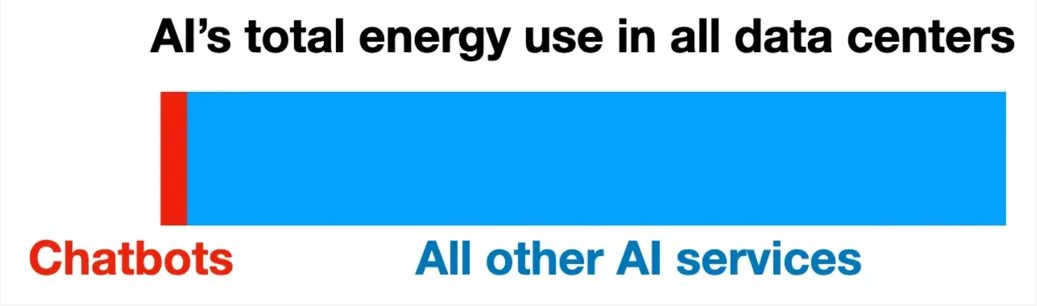
For comparison, YouTube currently uses about 1 percent of global energy - about ten times as much as the expected use of chatbots in 2030. Concerns about ChatGPT’s energy impact are therefore probably best weighed proportionally against other digital services.
Want to know more? Kai Williams (Williams, 2023) has written an article that uses 16 graphs to show what the growth of AI means.
#7.6CO2: How AI contributes to global warming
In the future, the energy needed for data centers could come from green and renewable sources - and a great deal of work is being done on that (OECD, 2022). But at the moment, this energy mainly comes from burning fossil fuels: coal and natural gas. This releases CO2 emissions. And although AI causes only part of the total amount of CO2 emissions, it is still important to understand the effects of increased CO2 concentrations in the atmosphere in order to properly assess the sometimes heated debates about it in the media, on social media, and in politics. This involves two important effects of increased CO2 concentrations in the air and their consequences. These are described in a compelling way by Andri Snær Magnason in the book ‘On Time and Water’ (2022). Below you can read more about those insights.
#7.6.1Global warming and its consequences
First, increased CO2 concentration causes global warming. Without additional climate policy, there is a risk that by around 2050 we will be heading toward 2 °C of warming. That may not seem like much, but it is. Especially because the effects differ by region and continent (and can therefore also be much greater):
- Large areas are already becoming uninhabitable (and even more so in the near future) because it is simply too hot to live there.
- More severe periods of drought and heavy rainfall disrupt crop growth.
- There will be more and larger forest and land fires.
- There will be more and larger floods.
- There will be more erosion and more fertile soil will wash away.
- The weather will become more extreme and fluctuate more unpredictably.
- More flooding and greater risks for areas that could end up under water.
All these phenomena have major consequences. Let us zoom in briefly on the accelerated disappearance of glaciers as an example. One medium-term effect is, for example, that areas whose residents depend on the water supplied by the rivers traditionally fed by these glaciers become uninhabitable. Think of densely populated areas in Asia (from rivers fed by glaciers in the Himalayas) and Latin America (rivers fed by glaciers in the Andes). This will cause large-scale population migrations. The melting of glaciers also raises sea levels. As a result, large low-lying coastal areas will become saline or be submerged. On the one hand, this creates problems for growing crops; on the other hand, it will set migration flows in motion. In addition, higher temperatures will cause the vast global tundras (large areas bordering a polar region and consisting of grasses, mosses, lichens, and dwarf shrubs) to thaw slowly. This releases large quantities of methane into the atmosphere. Methane has an even greater effect on retaining heat on Earth than CO2. This further accelerates global warming.
#7.6.2Ocean acidification and its consequences
Second, increased CO2 concentration causes higher acidity in the oceans. CO2 is absorbed by the oceans, but by now that amount is so great that it substantially changes the pH level of the water. As a result, calcium carbonate formation for organisms (shellfish and reefs) slows down or even stops, causing all life that feeds on these organisms to die out. This will have an enormous effect on biodiversity in the oceans and will also affect our food production through fisheries.
A great deal of work is being done to reduce CO2-emissions (for example, by capturing them directly at the source) or to capture CO2 from the atmosphere or seawater. However, these techniques are still in the early stages, and the scale needed to substantially lower the percentage of CO2 in the atmosphere is enormous. It would require an international approach and unprecedented investment.
#7.6.3Do you substantially reduce CO2-emissions by not using generative AI?
The demand for electricity will increase in the coming years. This does not necessarily have to lead to higher CO2emissions if governments and industry commit to a clean energy mix: from wind farms and solar fields to even nuclear power plants (although these, in turn, pose a waste problem in the long term).
However, as long as the world continues to rely heavily on burning fossil fuels to meet its energy needs, this will indeed lead to global problems. Many journalistic, social media, and even scientific sources argue that we shouldn’t use generative AI at all because of the environmental impact. And likely due to the novelty, speed, and scale of growth in the use of AI—and generative AI in particular—this point is heavily emphasized in climate discussions. How effective is that?
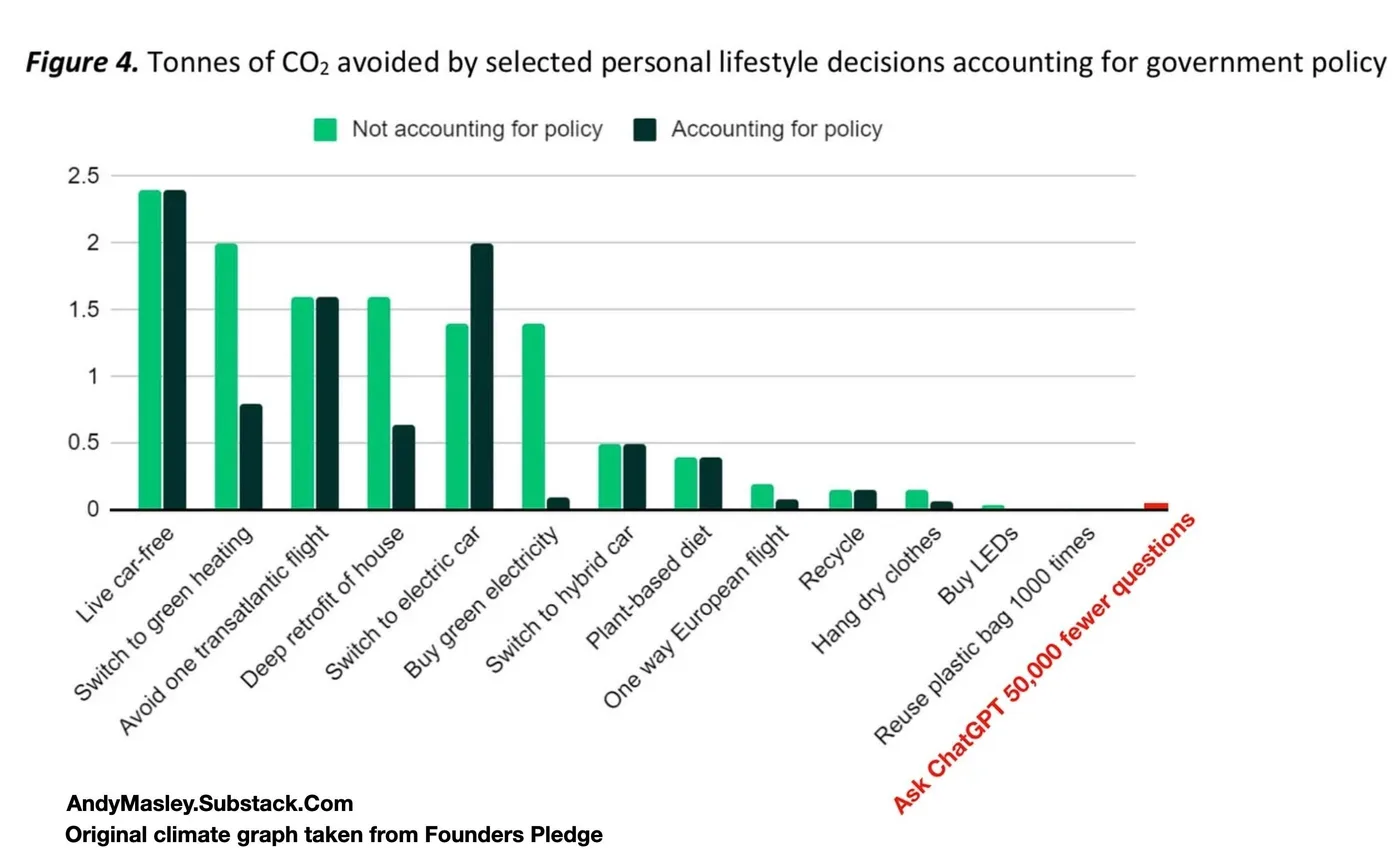
By placing other forms of CO2 emissions alongside AI use, you get a more realistic and broader perspective on the relationship between them. For that, Masley (2025a) analyzed changes in lifestyle and consumption patterns for their effects (See Figure 7.5). Masley shows how much CO2-emissions you can avoid by making other lifestyle decisions, compared with 50,000 fewer ChatGPT prompts. This shows that the share of ChatGPT prompts pales in comparison with other lifestyle changes such as no longer driving, skipping a flight once, becoming vegetarian, or hanging your clothes to dry instead of using the dryer.
Masley therefore wonders whether we would do better to focus our efforts on those factors instead of placing one-sided emphasis on the environmental burden of generative AI.
It is good to know who Masley is when you read Masley’s figures. Masley is not a scientist who publishes peer-reviewed research, but an essayist who shares analyses on a personal blog. Masley takes a clear position in them and wants to correct the idea that generative AI would be a major environmental problem. One of these pieces even carries the firm title that AI’s water problem would be "fake." That does not make the work unusable, because the comparisons are traceable and the underlying data are often verifiable. But it does mean you should read the conclusions as an argued position rather than as a neutral scientific finding. A good exercise in AI literacy is therefore to ask yourself: what choices does Masley make in these comparisons, and would a different choice lead to a different picture?
#7.7Water: why your AI gets thirsty too
#7.7.1Global and local water use
You may not realize it when you type in a prompt, but AI systems also use relatively large amounts of water (You, 2025). Servers in data centers generate a great deal of heat and therefore need to be cooled, currently still with water. On a global level, the impact of this is significant. Tech companies such as Microsoft, Meta, and Google together used about 2.2 billion cubic meters of water—comparable to the annual water consumption of all of Denmark. And this consumption is growing rapidly, with global demand in 2027 expected to amount to 4.2 to 6.6 billion cubic meters of water withdrawal (Li et al., 2025).
The biggest problem is not even the total scale of the water use (the water returns to the cycle), more on that later, but rather that it causes local problems: data centers are also being built in areas where water scarcity already exists. This leads to competing interests between the need for cooling water at data centers and water use for agriculture, industry, and households.
Mesa, for example, is a city in a desert region of Arizona that illustrates this problem well (Solon, 2021). One important reason local governments want to host data centers is jobs. And a desert region with lots of solar and wind power offers data centers cheap electricity. Arizona therefore seems suitable for a data center. But its water needs were not taken into account. The data center built in Mesa in 2021 uses up to 15 million liters of water per day, even though the region has been dealing with extreme drought for decades. Altogether, data centers in Mesa used more than 3.8 billion liters of water per year in 2021: enough to supply tens of thousands of households with water. This leads to major local tensions.
#7.7.2Water use per prompt
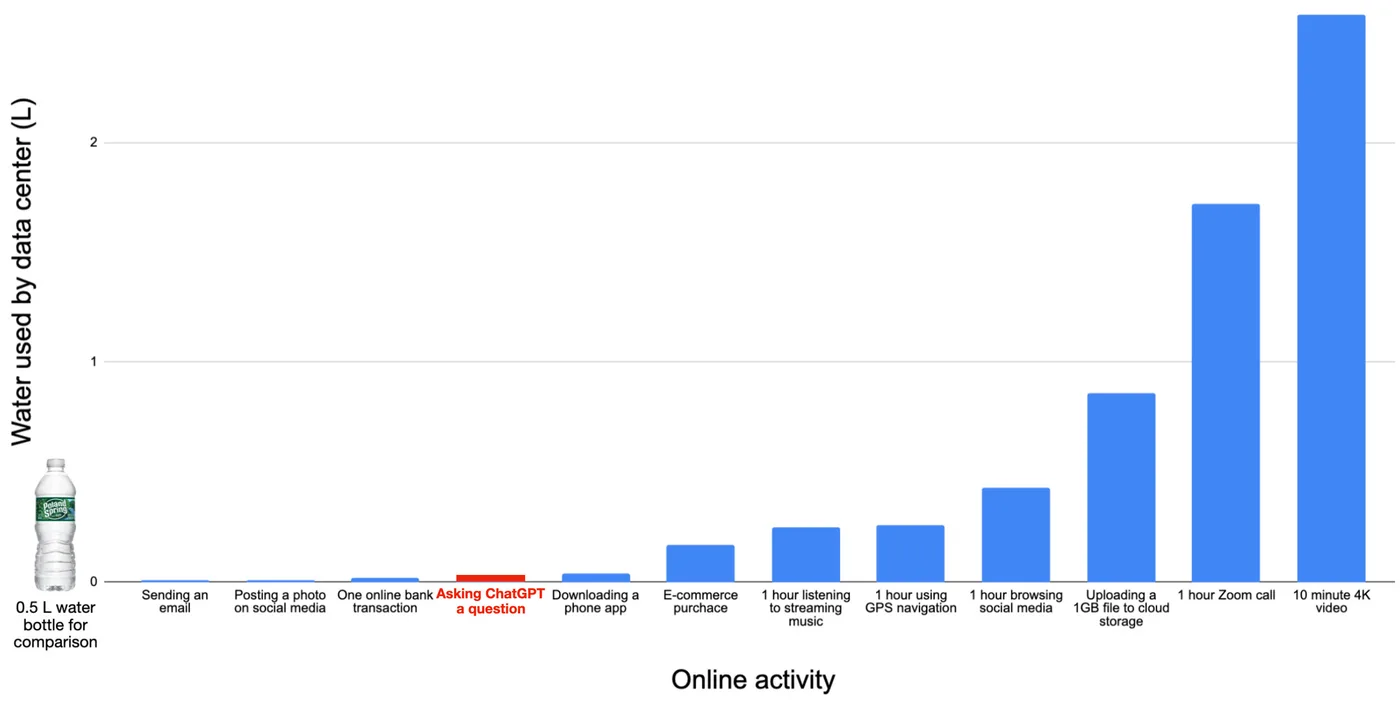
But how much water does generative AI actually use compared with other activities? In the media or online, you may often hear that a single prompt costs half a liter of water. But that is not correct: according to recent estimates, the amount of cooling water needed to process 10 to 50 prompts through ChatGPT is about half a liter of cooling water (Li et al., 2025). By comparison, Masley says that watching streaming videos in particular, for example, uses a great deal of energy and water. Masley also compares this with the water used to produce a hamburger (agriculture) or the total volume of water lost through leaks in the US. See Figure 7.6 and Figure 7.7. These considerations lead Masley to observe that the 500 milliliters of water used for twenty ChatGPT prompts can also be offset simply by showering five seconds less or skipping a hamburger.
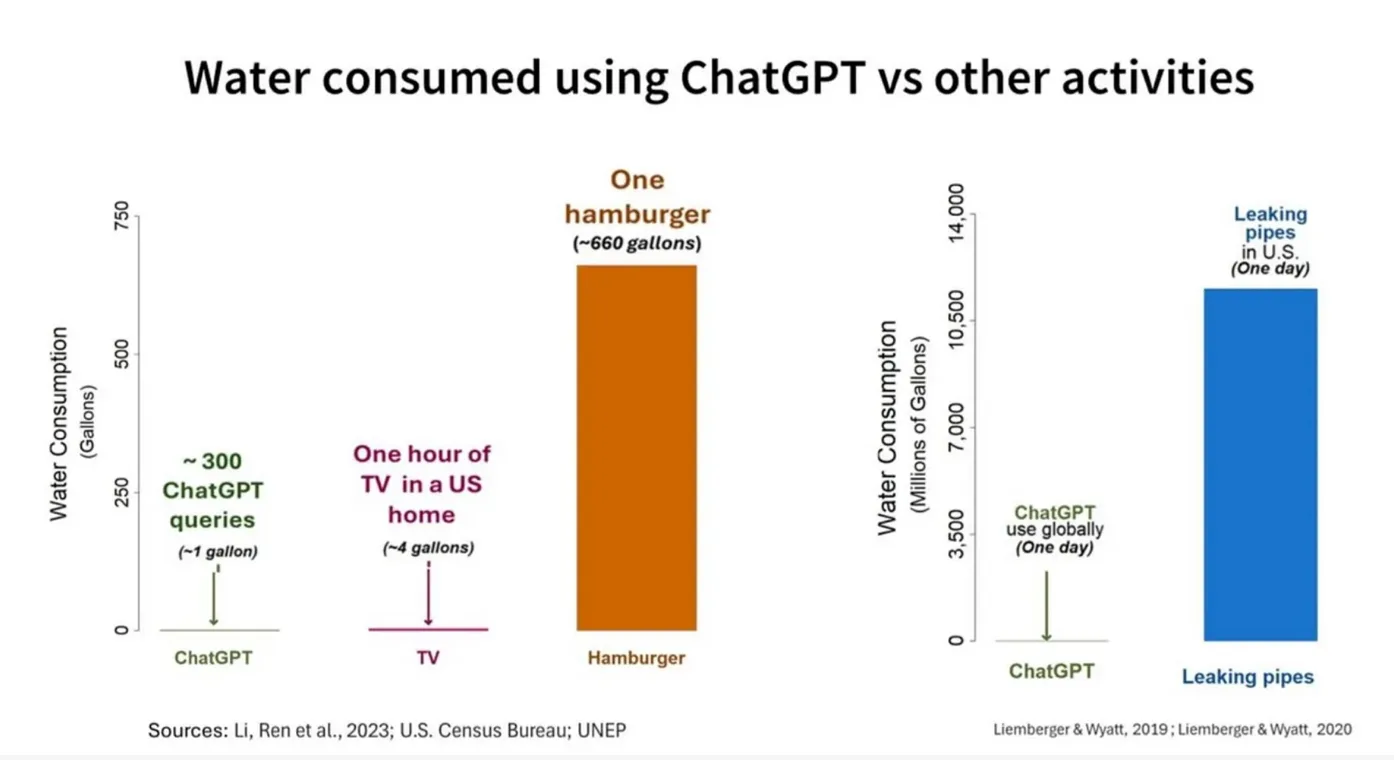
The question is not so much whether data center water use is inherently bad, but rather whether deliberate choices are being made. In water-rich areas, water use for data centers is probably not a problem, but in areas with water scarcity, every drop is an ethical consideration. The question should be: is this the best location for a data center? Are there alternatives for cooling? It is currently being investigated whether building data centers in space (“SpaceX neemt xAI over en wil datacenters in de ruimte bouwen,” 2026) or at sea, directly next to wind farms (“Vattenfall en Project Enki willen datacenters bouwen bij windparken op de Noordzee,” 2026), may be possible solutions. And how do the economic benefits compare with the ecological and social costs? Doesn't space become polluted? The water use of data centers is relatively small compared with agriculture, but in the context of extreme drought every liter counts.
#7.8When does AI actually help the environment?
So is AI always bad for the environment? Not necessarily. In a variety of sources, we find that AI applications can actually contribute to sustainability (Stern et al., 2025). Think of:
- optimizing energy use in buildings;
- faster analysis of climate data;
- predicting agricultural yields;
- planning logistics and mobility more efficiently.
- An example: Researchers from DeepMind, Google, and Trane Technologies had an AI system control the cooling systems of two large buildings for three months: a university campus and a complex containing stores, residences, and medical facilities. The system learned from sensor data and alternated daily with the standard control software. This resulted in energy savings of approximately 9 and 13 percent (Luo et al., 2022). The system continued to improve throughout the trial, and no new hardware was required.
- Another example is Project Green Light. In this initiative, Google analyzes anonymous traffic data from Google Maps. Based on this data, cities receive recommendations on how to adjust their existing traffic lights. In the first twelve participating cities - including Hamburg, Manchester, and Seattle - the modified intersections saw up to 30 percent fewer stops and up to 10 percent lower emissions (Matias, 2023). No new infrastructure is required, making this approach viable even for cities with smaller budgets.
- There is also serious opposition. Alpine et al. (2026) use a global energy-economy model and find that, on balance, productivity gains from AI lead to 0.47 to 1.8 Gt of additional CO₂ per year. The reason is that AI makes the fossil fuel sector at least as efficient as the renewable sector and thus encourages the use of fossil fuels. Furthermore, most of the positive figures are potential estimates or results from small-scale trials. Stern et al. and the IEA work with scenarios. The cooling trial was conducted at two locations. The figures from Green Light are “up to” values from a Google corporate blog and have not been independently verified.
Using AI for these kinds of applications is very complex, which makes it difficult to determine to what extent positive results actually come from them.
#7.9The information-energy paradox
Another perspective concerns the relationship between the energy use of digitization and generative AI and the amount of information it yields (Masley, 2025b)?If you put the energy use of digital information sources into perspective, a striking picture emerges. For 0.3 watt-hours—the amount of energy a ChatGPT prompt uses—you get, according to Masley, access to a synthesis of billions of documents' worth of knowledge. By comparison, looking up the same information in a physical library would take hours, including travel to the library, the lighting of the building, and possibly the printing or copying of sources. The shift from physical to digital information carriers has produced an enormous environmental gain that we often overlook, although it had already begun before the arrival of generative AI. A scientific journal that used to be mailed monthly to thousands of subscribers worldwide—with all the paper production, ink, transportation, and waste processing that entailed—is now accessible through a download of a few megabytes. Even if we include all server costs and individual energy use, the CO₂ footprint per article consulted has dropped drastically.
In addition, according to Masley, generative AI has the ability to multiply knowledge without a proportional increase in energy use. Once an AI model has been trained, it can serve millions of users at the same time, with each additional user adding only marginal cost. An AI-generated summary of complex scientific literature that would previously have required days of research is now produced in seconds for the energy cost of seven seconds of blow-drying your hair. This gives every student worldwide access to the same advanced AI tools without the environmental costs of international conferences, study visits, or shipping study materials. In that sense, the knowledge yield per watt-hour of modern AI systems is unprecedented—an efficiency that earlier information systems never came close to.
Still, something is unsettling. And that has to do with the scale at which everything is happening and the fact that new techniques—if they are cheap enough—lead to a multitude of applications that were not initially foreseen. The Jevons paradox explains this.
#7.10Where is this going? The Jevons Paradox
Even because of (or precisely because of) the fact that models and techniques are becoming more efficient, the total amount of energy required to train and use generative AI systems is growing.
How is this possible? An explanation is provided by the so-called Jevons Paradox. That theory does not predict much good (Polimeni et al., 2015): efficiency gains in (sub)systems are always accompanied by large growth in the energy demand of the overall system because that efficiency also makes more use cases and outputs of systems possible. And that certainly applies to AI and generative AI as well (Luccioni et al., 2025). Because the possible applications of generative AI - because it is relatively inexpensive - are growing at a dizzying pace and can be made available to vast numbers of users at almost no additional cost. In other words, cheaper and more energy-efficient digital processors actually drive increasing demand for digital generative AI services, and with it the energy demand.
At the same time, it is important to also consider the relative contribution of generative AI to environmental impact compared with other activities, and the savings from the paradoxical perspective in paragraph 7.9 in your considerations. Ask yourself: is there a provider that uses renewable energy sources? For example, data centers that you know run on solar or wind power. And don’t just look at the costs of using AI—also factor your goal into your decision-making. You want to look something up or create something, but is generative AI really necessary for that? Don’t just ask, “How much energy does this consume?” but also, “What value does this provide?” Critical use of AI is then no longer the result of a cost analysis, but of a—more comprehensive—cost-benefit analysis. What do you think?
These two sides—the nuance offered by Masley and the warning conveyed by the Jevons paradox—do not have to exclude each other. Data researcher Hannah Ritchie describes in the book Not the End of the World (2024) how you can put facts into perspective without slipping into indifference. Ritchie's stance can be summarized as “urgent but not self-satisfied”: the figures show that many doom scenarios are exaggerated, but that is a reason to act purposefully, not to sit back. Note that Ritchie writes about the environment in general, not about AI, and describes an attitude rather than something about AI. For your AI use, this means that you can put the environmental impact of a single prompt in perspective, while at the same time continuing to take seriously the fact that AI's total energy and water use worldwide is growing substantially and calls for real choices.
As with other technologies, the key lies in responsible use and careful consideration:
- Don't use AI just because you can; use it because it actually improves the desired outcome.
- Choose consciously whether to use devices or services less in general—especially airplanes and cars.
- Choose a different lifestyle to reduce strain on energy resources and the environment; for example, become a vegetarian or flexitarian, watch fewer YouTube videos, and limit your use of social media.
- Choose consciously whether or not to use AI applications in relation to the information-energy paradox and the Jevons Paradox.
- Even if you use generative AI and find it useful, support any (future) regulatory requirements aimed at reducing its use.
- Don’t just ask, “How much energy does this consume?” but also, “What value does this provide?”
7.11Self-study questions
#7.11.1Review questions
According to the book, how much energy does an average ChatGPT prompt use compared with a Google search?
Why do AI data centers need water, and about how much water does it take to process 20 to 50 simple prompts?
Name two ways AI applications can actually contribute to sustainability.
7.11.2Reflection questions
- Suppose you use about 50 AI prompts every day for your studies. How would you weigh this energy use against other choices you could make to reduce your ecological footprint? Explain how you would make that trade-off.
- Ritchie (2024) argues that looking at data soberly actually creates room to act. Do you find that convincing, or do you run the risk that putting things in perspective turns into looking away? Support your answer. Does this make you think differently about when you do or do not use AI?
- Listen to this podcast from Trouw and try to formulate some criticism of the podcast's apparent message.

7.11.3Suggested answers
- An average ChatGPT prompt uses about 0.3 watt-hours, which is comparable to a Google search. Earlier models used about 2.9 watt-hours, almost ten times as much, but this has dropped sharply due to technological progress. At the same time, models are becoming more powerful, which requires more energy. But processors are becoming more efficient again. That in turn requires more energy. Basically, nobody knows exactly where this is headed.
- AI data centers need water to cool the servers that generate a lot of heat. About 500 ml of water is needed on average for roughly 20 to 50 simple prompts, depending on the model, the prompt length, and the location of the data center.
- AI can contribute to sustainability through, for example, optimizing energy use in buildings, faster analysis of climate data, predicting agricultural yields, and planning logistics and mobility more efficiently.
- 50 prompts per day cost about 15 watt-hours, which comes to 5.5 kilowatt-hours per year. This is comparable to showering about 5 seconds less per day or watching YouTube for a few fewer minutes. You could weigh this against the fact that other choices, such as flying less, eating vegetarian, or driving less, have a much greater impact on your ecological footprint.
- This is a personal reflection in which you might consider that the information makes you more aware of the relative impact of different activities. You might conclude that you can still use AI responsibly for meaningful purposes, but perhaps become more aware of excessive use. Or you may realize that other lifestyle choices matter more for the environment than limiting AI use. Or that you want to raise the issue of energy waste within your organization or through laws and regulations.
- The podcast seems to endorse the general tendency to say that generative AI is bad for the environment. But in making that point, everything related to digitization is lumped together. You can argue that this improperly exaggerates the discussion about the impact of generative AI.